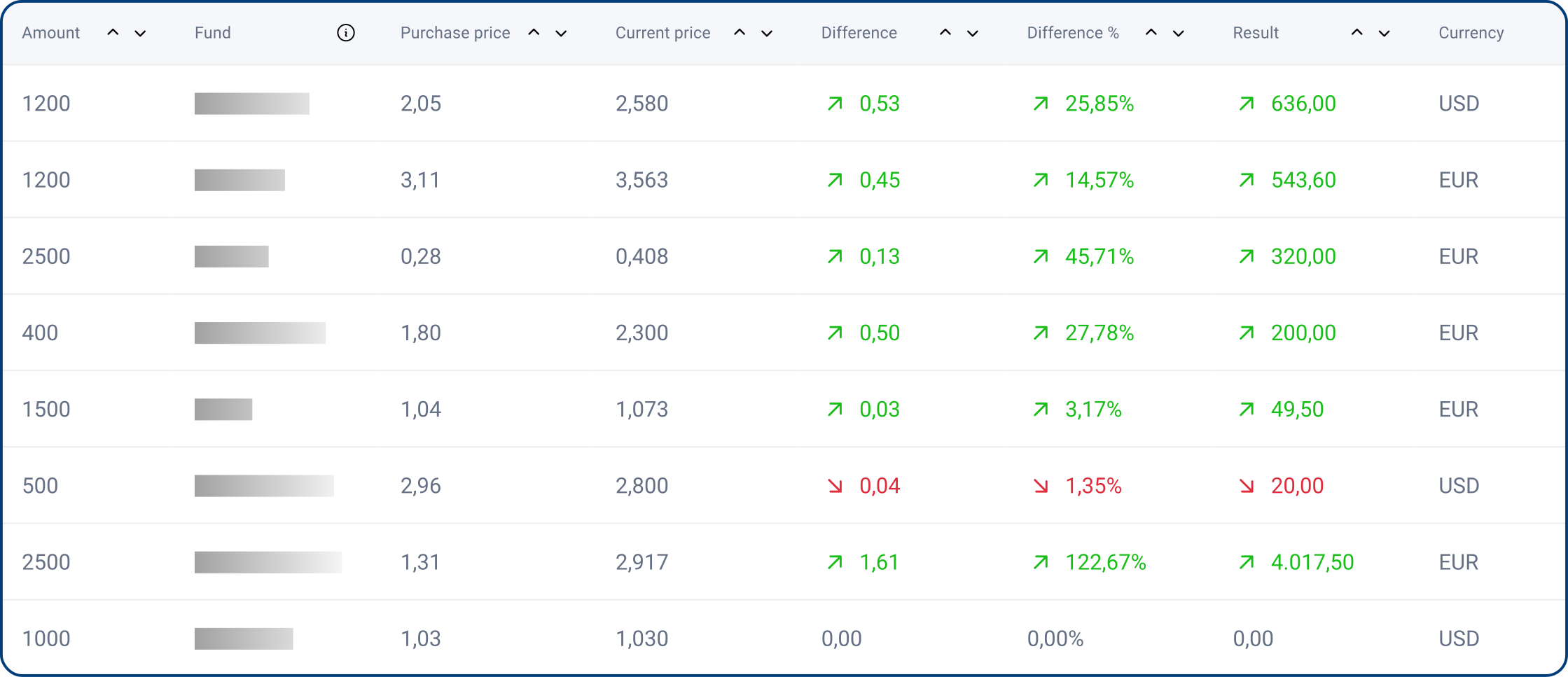








You can follow our portfolio and take advantage of it. Our portfolio is not a buy recommendation.

Discover high-potential shares under £10. Backed by results. Updated weekly.

35% return in 2025. Join members who consistently outperform the market.

The many benefits of our exclusive platform

24/7 access to our portfolio

As a subscriber, you have round-the-clock access to our website, where you can view all the information about our current portfolio, including the latest results.

Regular portfolio updates

We regularly send subscribers our update, where we cover the overall economic outlook and news about stocks in our portfolio.

Support from our analysts

As a subscriber, you can always email our team with any general questions about our portfolio.

Featured in:

Latest updates & analyses

Updates

Relief in Oil, Political Noise in London

The past week was largely shaped by two opposing forces: relief over lower energy prices and renewed caution around interest rates and inflation. The first round of talks between Iran and the United States produced a roadmap for further negotiations. The goal is to work toward a more definitive peace agreement within the next sixty days. For markets, the most important outcome was an agreement aimed at preventing incidents and miscommunication around shipping traffic in the Strait of Hormuz. Oil prices reacted by moving lower, providing immediate relief to inflation concerns. However, this is not a situation where investors can simply erase geopolitical risk from the equation. Israel is not part of the negotiations, and security conditions in Lebanon remain fragile. That captures the current market environment well: reduced short-term stress around oil helps, but the underlying risks have not disappeared. As a result, some areas of the market welcomed the news while investors remained hesitant to draw broad conclusions. Adding to the uncertainty, political developments in the United Kingdom came into focus. According to British media reports, Prime Minister Keir Starmer is expected to announce a timeline for his departure following growing pressure within the Labour Party and the return of Andy Burnham to Parliament. For financial markets, this matters primarily through the British pound, government bonds, and domestically focused UK equities. An orderly leadership transition could limit the damage, but fresh political uncertainty arrives at a time when the UK is already grappling with interest rates, consumer purchasing power, and budget constraints. In both the United States and the United Kingdom, central banks left interest rates unchanged, but their message remained cautious. Inflation has not yet been defeated, and investors should not assume rate cuts are imminent. In the UK, two policymakers even voted in favor of a rate hike despite softer inflation data for May. Smaller and rate-sensitive companies could recover strongly if rate expectations begin to shift, but they remain vulnerable as long as central banks maintain a restrictive stance. This week, investors are primarily focused on the United States. Attention will center on the PCE inflation report, the Federal Reserve’s preferred inflation gauge. The data is scheduled for release on Thursday. Alongside our existing portfolio, we are currently evaluating a new company within the real estate sector—but not a traditional property owner. Instead, the company generates revenue through services related to real estate. As a result, the stock remains highly sensitive to interest rate expectations. When rates rise, the market tends to punish the shares. When rates fall, higher valuations typically follow. What interests us is that the business appears to be gradually reducing its dependence on rate movements. Its service offering is becoming broader, revenue streams are becoming more stable, and yet the market still seems to value the company as though it were entirely tied to real estate cycles and interest rate fears. That disconnect may create an opportunity. We will share our full analysis with members via email in the near future. BP For BP, the week was largely driven by developments in the oil market. The roadmap for continued peace negotiations between Iran and the United States put downward pressure on oil prices as investors priced in less risk around the Strait of Hormuz. For BP, this cuts both ways. Reduced geopolitical tension is positive for inflation and overall market sentiment, but lower oil prices can also dampen cash flow expectations. For us, BP remains primarily a story of execution. The market wants proof that the company can maintain discipline and continue delivering attractive shareholder returns even in a more normal oil price environment. Lower oil prices are not necessarily negative if they coincide with lower geopolitical risk and softer inflation, but they do reduce the margin for additional shareholder distributions. We continue to view BP as a company where evidence matters more than promises: consistent execution, stability within management, and sufficient free cash flow, even without exceptionally high oil prices. Rolls-Royce Rolls-Royce received further support from the nuclear sector during this period. The company was selected for three small modular reactor projects in Sweden and also entered into a partnership with British and Japanese nuclear organizations focused on advanced reactor technology. This is meaningful because it further strengthens Rolls-Royce’s position in the small modular reactor market beyond its home market. What matters most to us is repeatability. Investors are no longer valuing Rolls-Royce solely on the aviation cycle; increasingly, the question is whether new growth engines can scale successfully. The Swedish selection confirms that the technology is being taken seriously on an international level. At the same time, this remains a long-term story. Reactor projects involve lengthy timelines, political risks, and execution challenges. Shares Under Ten therefore views this development as positive for the strategic investment case, though it is unlikely to materially affect earnings in the short term. Deceuninck On June 19, Deceuninck released a transparency notification showing that Gramo, Holve, and Francis Van Eeckhout had jointly surpassed the 30% voting rights threshold. Their combined position now stands at 30.52%. This matters because ownership structure and control are becoming increasingly important factors in the Deceuninck story. From an investment perspective, the stock is now viewed less as a traditional industrial small-cap and more as a situation involving control, valuation, and potential takeover dynamics. Operationally, the announcement changes nothing regarding demand for window and door systems, margins, or a recovery in European markets. However, for minority shareholders, shifts in voting power and influence remain highly relevant. Shares Under Ten sees this development as one that warrants close attention to valuation, governance, and the protection of minority shareholder interests. Global Dominion Access Global Dominion Access has struggled somewhat in recent months. There was little significant company-specific news over the past week, which largely reflects the current situation: no major problems, but also no obvious catalyst that would force the market to reassess the stock. For Shares Under Ten, this does not change the core investment thesis. This is the type

Read more >
Updates

Framework agreement between the US and Iran brings relief to the stock market

Last night, we were surprised by news from the Middle East. US President Donald Trump announced that the United States and Iran have reached an agreement. According to Trump, the Strait of Hormuz will be fully reopened and the US naval blockade will be lifted. Pakistani Prime Minister Shehbaz Sharif also confirmed that both parties have agreed to a permanent end to military operations. The official signing is expected to take place in Switzerland on 19 June.

Read more >
Breaking news

BREAKING NEWS: We Are Taking a Position Again!

Our previous purchase of JD Logistics proved to be a successful investment. Following our initial buy recommendation, the stock rose sharply, allowing us to realise a 25% gain in just one month. This type of company requires an active investment approach, which is why we have continued to monitor the stock closely over the past few weeks. Our original investment thesis remains fully intact. JD Logistics still operates one of the most advanced logistics networks in China, with strong positions in automation, supply chain software, and AI-driven infrastructure. At the same time, the valuation remains exceptionally low. The company continues to trade at an EV/EBITDA multiple of around 3.5x, despite strong free cash flow growth and a positive net cash position. We also believe a potential takeover by parent company JD.com cannot be ruled out. Just as we did previously, we are adding 1,500 shares to the portfolio. Following its quarterly earnings release on 12 May, JD Logistics initially rallied strongly. The company reported revenue growth of 29% to RMB 60.6 billion, while profit increased by more than 40%. Gross profit also showed a substantial improvement. Operationally, the results were particularly impressive. JD Logistics continues to expand aggressively outside China. During the first quarter, JoyExpress was launched across major European markets, including the Netherlands, Germany, France, and the United Kingdom. In addition, the company continues to invest heavily in automation, artificial intelligence, and robotics throughout its logistics network. Despite the strong results, market sentiment quickly turned negative again after the initial share price surge. Investors appear to be focusing primarily on the company’s rising cost base. JD Logistics is investing heavily in personnel, warehouses, freight capacity, and technology. As a result, operating expenses increased significantly. While the market initially reacted positively to the company’s growth figures, attention soon shifted almost entirely towards lower margins and the substantial level of ongoing investment. Conclusion Sharesunderten believes the market is once again focusing too heavily on the short term. In our view, JD Logistics’ operational position continues to strengthen. Approximately 68% of revenue now comes from external customers outside JD.com, allowing the company to evolve into an independent logistics platform rather than merely serving as JD.com’s internal delivery arm. Its international expansion is also progressing at an impressive pace. JD Logistics now operates more than 1,600 owned warehouses and maintains a logistics network covering virtually every region in China. At the same time, its European network is being rolled out rapidly. We believe this combination once again creates an attractive opportunity. Operational performance remains strong, while the share price continues to be driven largely by short-term market sentiment. We therefore do not view the recent pullback as a deterioration of the long-term investment case, but rather as a new opportunity to acquire a high-quality infrastructure business at an exceptionally attractive valuation. We are reiterating our Buy recommendation. Major ShareholdersJD.com: 63%Core Trust: 7.5% Fundamental DataCompany Name: JD Logistics, Inc.Ticker: 2618ISIN: KYG5074S1012Sector: LogisticsExchange: Hong Kong Stock ExchangeEUR/HKD Exchange Rate: 9.1Share Price (9 June): HKD 12.67 (£1.20)52-Week Low: HKD 10.2052-Week High: HKD 16.76Market Capitalisation: HKD 88.9 billion (£8.5 billion)Net Cash Position: HKD 6.5 billionPrice-to-Earnings Ratio (P/E): 7.0xDividend Yield: 0.0%Next Results: AugustWebsite: https://ir.jdl.com/?lang=en

Read more >
Updates

Markets Search for Direction, Individual Stocks Make the Difference

It is becoming increasingly clear what impact the war in Iran is having on the global economy and Western countries. While the conflicts in Ukraine and Gaza had only limited direct economic consequences for many European consumers, the situation with Iran is different. The reason is simple: oil. In recent weeks, it has become painfully clear how much economic activity is ultimately tied to the oil price. Higher oil prices not only mean more expensive fuel at the pump, but also higher transportation costs, more expensive production processes and rising energy bills. As a result, consumers have less money left to spend on other goods and services. This could slow economic growth at a time when many economies are cautiously emerging from a period of high inflation. Despite this, stock markets have remained relatively resilient. One reason is that investors are becoming increasingly selective. After the strong market gains of recent years, expectations are high and companies are being judged more individually on their own performance. Strong results are rewarded, while disappointments are punished quickly and sometimes severely. This is precisely why individual stocks appear to be more important than the indices themselves at the moment. While many indices are trading near record highs, significant differences are emerging beneath the surface between winners and losers. This fits well with the philosophy of SharesUnderTen. Rather than trying to predict where an index will be next month, we focus on identifying individual companies with attractive valuations, healthy balance sheets and clear catalysts for future share price appreciation. History also shows that indices are constantly changing. Companies that once dominated the FTSE have disappeared, while new names have taken their place. Ultimately, successful investing is not about following an index, but about selecting strong businesses capable of creating long-term value for shareholders. The coming week will be largely focused on inflation and central banks. On Wednesday, the latest US Consumer Price Index (CPI) data will be released. Investors expect inflation to have risen further to 4.2% year-on-year, partly due to higher energy prices. A higher inflation reading could push expectations for Federal Reserve rate cuts further into the future. Attention then shifts to Europe on Thursday, when the European Central Bank announces its latest interest rate decision, followed by a press conference from ECB President Christine Lagarde. The week concludes on Friday with UK GDP data, providing investors with additional insight into the health of the British economy and the room available for future Bank of England rate cuts. Rolls-Royce News surrounding Rolls-Royce remained positive over the past week. The company secured several notable contracts, including a major battery energy storage project in Latvia, further strengthening its position within the energy transition market. Demand for aircraft engine maintenance and servicing also remains strong, continuing to be the company’s primary earnings driver. The outlook for the aviation sector remains favourable as well. Global air traffic continues to increase, resulting in more flying hours for airlines and therefore greater maintenance requirements. This provides strong and predictable cash flows within Rolls-Royce’s highly profitable Civil Aerospace division. Last week, we decided to sell part of our position. Following the substantial share price appreciation of recent years, we felt it was prudent to lock in some profits. However, this does not change our confidence in the remaining position. Operational performance continues to improve, order intake remains strong and management is executing its strategy successfully. Sharesunderten therefore remains positive on Rolls-Royce. While the stock is no longer as cheap as it was several years ago, we still see a high-quality business benefiting from long-term growth trends across aviation, defence and energy. For that reason, we are pleased to remain invested after taking partial profits. BP At BP, the main focus over the past week was the continued simplification of its portfolio. According to several media reports, the company is in advanced discussions with Ithaca Energy regarding the sale of a number of North Sea assets for approximately £2 billion. Such a transaction fits well within the strategy of CEO Murray Auchincloss, who has placed greater emphasis on profitable oil and gas operations and freeing up capital since taking over leadership. BP also continued streamlining its organisation. It was announced that operational responsibilities for the Baku-Tbilisi-Ceyhan pipeline will be transferred to Azerbaijan’s state oil company. This aligns with the broader strategy of allocating capital more efficiently and optimising the portfolio. The oil price remains the most important factor influencing sentiment towards BP. Developments in Iran and ongoing uncertainty surrounding the Strait of Hormuz continue to affect energy markets. At the same time, BP is demonstrating that it is actively strengthening its balance sheet and improving shareholder returns regardless of oil price movements. BP remains attractively valued, offers a strong dividend yield and could benefit from additional financial flexibility through its ongoing asset disposals. We therefore remain positive on the stock and view these developments as confirmation that the company is moving in the right strategic direction. Sunny Optical Sunny Optical announced that it is considering issuing approximately RMB 3 billion in so-called Dim Sum Bonds. At first glance, this may seem surprising given the company’s strong balance sheet and more than 70% profit growth in 2025. However, we view this primarily as a logical financial decision. The proceeds from the new bond issue are expected to be used to refinance an existing $400 million bond, equivalent to approximately RMB 2.7 billion, which matures in July 2026. Rather than paying off the entire amount from its cash reserves, Sunny Optical is choosing to refinance the debt under favourable terms. This allows the company to maintain financial flexibility for future investments in research and development while also reducing part of its currency exposure. The existing debt is denominated in US dollars, whereas the new bonds will be issued in Chinese renminbi. Since the majority of Sunny Optical’s revenue and earnings are generated in renminbi, this creates a better match between its income and liabilities. SharesUnderTen does not view this move as

Read more >
Updates

The Calm Seems to Be Returning, but Markets Remain Alert

Global equity markets continue to hit new record highs. We are seeing calm gradually return, but the market remains alert. That is hardly surprising. Rising inflation, elevated bond yields, and an increasingly hawkish tone from central banks are making investors more selective. In Europe in particular, expectations are growing that the ECB will raise interest rates again in June, while the US Federal Reserve also appears to have little room to cut rates quickly for the time being. As a result, attention is shifting more and more toward companies with strong balance sheets, healthy cash flows, and limited debt. That aligns well with the way we look at stocks. The focus is once again returning to quality. At the same time, an important source of uncertainty seems to be slowly fading. In recent weeks, much of the attention was focused on tensions between the United States and Iran. There now appears to be cautious progress toward a diplomatic solution. Discussions are underway about extending the ceasefire and continuing negotiations on Iran’s nuclear program. Although the situation remains fragile and new incidents cannot be ruled out, the market increasingly seems to believe that both sides want to avoid further escalation. This is also reflected in the oil price, which has fallen back noticeably over the past week. For the week ahead, we are mainly watching the United Kingdom. On Tuesday, the Manufacturing PMI will be released, followed by several speeches from Bank of England Governor Andrew Bailey. Then, on Friday, the most important UK figure of the week is on the agenda: labour market data. These numbers are especially important at the moment because UK interest rates have remained elevated for quite some time, and investors are looking for clues about the Bank of England’s next policy moves. A cooling labour market could reduce pressure for further rate hikes, while strong data could once again fuel fears of higher rates. In addition, investors will of course also be watching the US labour market figures on Friday. Still, we expect that the main focus this week will be on the United Kingdom, where economic developments are becoming increasingly important for several stocks in our portfolio. Sunny Optical During last week’s annual general meeting and extraordinary general meeting of Sunny Optical Technology, all proposed resolutions were approved. Shareholders gave near-unanimous support to the 2025 annual accounts and the final dividend. All directors were also re-elected. In addition, the board was authorised to issue up to 10% new shares and to repurchase up to 10% of the shares outstanding. At the extraordinary general meeting, the main focus was on remuneration policy. Shareholders approved the introduction of a new 2026 Share Award Scheme, an equity incentive programme for employees and management, as well as a related cap on awards to external service providers. Taken together, the voting results paint a clear picture of shareholder sentiment. There is broad support for the current board, the dividend policy, and especially share buyback programmes. At the same time, shareholders are noticeably more critical when proposals could lead to dilution of their stake, such as share issuances and new equity-based compensation schemes. The stock finally seems to be gaining some momentum. That is why we are keeping Sunny Optical Technology in the portfolio. Rolls-Royce Sometimes there comes a moment when you have to say goodbye to a winner. For us, that moment has now arrived with Rolls-Royce. More than four years ago, we added the stock to the portfolio at a time when many investors had written the company off. Since then, we have enjoyed an impressive ride, delivering a return of 1,500%. Although we remain positive about the long-term opportunities of, among other things, small modular reactors and the role Rolls-Royce could play in the market for mobile nuclear power plants, we believe the stock now reflects a large part of that optimism. We also believe it is important to stay disciplined and occasionally take profits when an investment has largely fulfilled its potential. Rolls-Royce helped us through difficult market years with an impressive share price performance and eventually also resumed paying dividends. Under its current management, the company has undergone an impressive transformation, and we as shareholders have benefited greatly from that. However, every success story eventually comes to an end. Rolls-Royce’s valuation has risen sharply in recent times. Because the expected price/earnings ratio for 2028 is now around 25, we believe it is wise to lock in part of the gains achieved. The market is currently very optimistic. That is why we are taking a balanced approach: if the stock rises further, we will still benefit through our remaining position. If the share price falls, we will already have secured part of our profits and may be able to buy back at a more attractive level. That is why SharesUnderTen has decided to sell 65% of its position in Rolls-Royce. We look back very positively on the returns achieved so far and will continue to follow the stock with close interest. Brunel Brunel came under pressure last week because the stock traded ex-dividend on 25 May. As a result, the share price usually falls on the ex-dividend date by roughly the amount of the dividend. For 2025, Brunel is paying a total dividend of €0.35 per share. This consists of a regular dividend of €0.06 per share and a special dividend of €0.29 per share. The unusually high special dividend in particular explains why the price reaction was relatively large. The dividend will be paid on 18 June 2026. We are happy to put that dividend in our pocket. In addition, we still expect a lot from Brunel. Management has indicated that it sees opportunities to further improve results, and investors appear to have confidence in those plans. That is why we are maintaining the position. Envipco We are now up more than 10% on our position in Envipco. Other parties are also beginning to show enthusiasm. For example, Sweden’s Handelsbanken Fonder has built a

Read more >
Updates

Inflation, Oil and Debt Keep Markets on Edge

From a macroeconomic perspective, the Middle East remains the main issue weighing on markets, although the initial panic reaction appears to be fading. Where investors had previously responded very sharply to every new headline, the conflict now seems to be slipping more into the background. Despite fresh US strikes on targets in southern Iran, there has so far been no real escalation in the financial markets. Oil prices have also reacted less dramatically than before. Brent crude has now fallen back below $100 per barrel, suggesting that investors are still pricing in the possibility of a diplomatic solution and the reopening of the Strait of Hormuz. At the same time, rising inflation and interest rate concerns remain a key theme for equity markets. For a long time, markets expected several rate cuts from central banks, but that picture is now beginning to shift. Higher energy prices and sticky inflation mean central banks will likely need to remain cautious for longer. Bond markets in particular are already sending clear signals, with yields rising in both the United States and Europe. This is putting more pressure on highly valued growth stocks and companies with heavy debt burdens. Investors are also taking a more critical view of the enormous level of investment in AI. Several analysts warn that an increasing share of those investments is being financed through debt. As long as operating cash flows remain strong, that is not necessarily a problem. But if companies can no longer support their investment levels with cash flow generation, credit downgrades may follow and profitability could come under pressure. The technology sector in particular is therefore facing more scrutiny on valuations. According to Shares Underten analysts, stock picking is therefore becoming increasingly important. In a market where money is no longer free, attention is shifting back to companies with strong balance sheets, healthy cash flows, profitability and attractive valuations. According to Shares Underten, volatile markets create opportunities for investors willing to look beyond the short term. Those willing to think small can grow big as investors. On the macro front, the Chicago Fed Index came in positive and once again pointed to an acceleration in the US economy. This week, the focus is mainly on important US macroeconomic data. On Thursday, markets will receive the Core PCE Price Index, the Federal Reserve’s preferred inflation gauge, alongside preliminary US GDP growth data. On Friday, investors will focus in particular on a speech by Bank of England Governor Andrew Bailey. Grafton Group Grafton released a trading update covering the first four months of 2026. Revenue rose by 3.2% to £830.1 million, while like-for-like revenue remained stable. Ireland, Northern Europe and Iberia all delivered growth, while the UK performed more weakly due to a difficult construction market and cautious consumer spending. Grafton also continues to invest actively in growth. The company recently completed acquisitions in Spain and Ireland, further strengthening its position in two fast-growing markets. Shares Underten sees the expansion in Iberia and the company’s increasing exposure to the Irish new-build market as particularly positive for the longer term. Despite the weak UK market, Grafton still expects adjusted operating profit for full-year 2026 to come in between £190 million and £200 million. The company also has a strong balance sheet and continues to buy back shares, underlining management’s confidence. While market conditions remain challenging in the short term, Shares Underten still sees long-term potential in Grafton Group. Its geographic diversification, strong market positions and focus on growth mean the shares remain in the portfolio. Vanquis Banking This UK banking stock is still relatively new to the portfolio, and the share price has so far moved fairly quietly. Even so, Shares Underten sees considerable potential in this specialist British lender. While Vanquis was once mainly known for riskier lending, the company has deliberately changed course under CEO Ian McLaughlin. The focus is shifting increasingly towards safer lending and a more stable credit portfolio. The market still seems to judge Vanquis on its past, while the numbers show that the recovery is becoming increasingly structural. The bank returned to profitability again in the first quarter, while the loan book continues to grow and credit quality remains stable. That last point is crucial according to Shares Underten, as that is where the company historically ran into problems. In addition, operational leverage is becoming increasingly visible. Vanquis is investing heavily in automation and AI, which should materially reduce its cost base in the years ahead. That means profits could eventually grow faster than revenues. In valuation terms, Shares Underten also continues to see the stock as attractive. The shares still trade well below tangible book value per share. If the market gains more confidence in the structural recovery and the new strategy, part of that gap could close. Shares Underten therefore remains positive on Vanquis Banking and sees the stock as a classic recovery story with longer-term upside. Kudelski Kudelski’s share price performance in recent weeks has undoubtedly been disappointing. The decline appears to be mainly driven by concerns over profitability and weak market sentiment towards smaller technology companies. Analysts have recently cut their earnings expectations sharply, putting additional pressure on the stock. Kudelski also continues to carry a relatively high debt burden. The 2025 annual results did little to reassure investors. Revenue came in around 9% below analysts’ expectations and, while the net loss narrowed, the company remained loss-making. The stock has also underperformed the broader market for some time and is now trading below its 200-day moving average, which is not a strong technical signal. The broader market environment is not helping either. European equity markets are under pressure from geopolitical tensions and higher energy costs, with smaller technology companies particularly sensitive to negative sentiment. Even so, Shares Underten is maintaining its buy recommendation. Kudelski is in the middle of a restructuring process, with the business increasingly shifting its focus towards cybersecurity and IoT. At the same time, the company is working on cost reductions to improve profitability.

Read more >

Success stories:

Our portfolio